
From the flicker of early moving pictures to digital cinema, the equipment behind the audience has transformed the experience on screen.
Moving pictures meet an audience
Cinema emerged through the work of several inventors and showmen. One of its defining milestones was the Lumière brothers’ paying public Cinématographe programme at the Grand Café in Paris on 28 December 1895.
These early programmes featured short films. The familiar arrangement of two projectors alternating through a long feature developed later, as films and cinema programmes grew longer.
Two projectors. One continuous story.
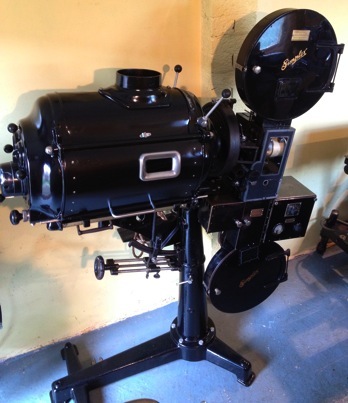
For much of the 35mm era, cinemas used two projectors. While one reel played, the projectionist prepared the next reel on the second machine. Cue marks near the end of the reel signalled when to start the next projector and change over the picture and sound.
A 2,000-foot reel runs for approximately 22 minutes at 24 frames per second. The projectionist alternated between the machines, rewinding and preparing reels throughout the performance.
Reel capacity and nitrate-film fire precautions were central to the British changeover system. Carbon rods also needed regular attention and replacement, but their useful burning time varied: it is too simple to say that every carbon arc lasted only twenty minutes.
The arrival of synchronised sound
The transition to sound changed projection-room equipment and working practices. Early systems included sound on separate discs, while optical soundtracks carried the audio alongside the images on the film itself.
Projection became a matter of presenting both picture and sound reliably, with sound-era 35mm normally running at 24 frames per second.
A wider screen, a bigger experience
Widescreen presentation brought new lenses, screen shapes and projection requirements. CinemaScope and 70mm were among the developments that helped cinemas offer a larger, more immersive spectacle.
From carbon arcs to xenon
Carbon-arc lamphouses produced their brilliant light using an electrical arc between carbon rods, which were consumed during use. Xenon lamps offered a light source that could operate throughout a feature without replacing carbon rods.
Osram dates its XBO cinema xenon lamp to 1954. Adoption was gradual, with carbon arcs and xenon systems overlapping for years.
The whole film on one projector
Long-play systems became increasingly common. Individual reels were joined to form a complete programme, handled by a platter system—often nicknamed a “cake stand”—or a tower system using large reels.
Combined with xenon illumination, these film-handling systems allowed one projector to run an entire feature without reel-by-reel changeovers. They became a familiar part of cinema operation for decades, although twin-projector installations also continued.
From film reels to digital files
Digital cinema gradually replaced physical release prints with files played through a cinema server or media block and a digital projector. DCP stands for Digital Cinema Package: the package of picture, sound and associated data used to deliver a film.
The first Digital Cinema Initiatives system specification was published on 20 July 2005, a major standardisation milestone. Digital projection existed before this date; the change from film took place over many years.
Film versus digital describes how the picture is stored and presented. Xenon versus laser describes the light source. Digital cinema projectors can use xenon lamps as well as laser illumination.
.